
CrossBar Ostros
Technical overview.
What runs under your app, how to verify it, and what the Founders Edition ships with.
Build on a stack you can verify.
Every layer, from the applications down to the chip logic, comes with its source code and licence. Only boot0 is locked.
The build is deterministic: build the firmware from the published source and compare your hash with the hash of the published firmware.
07Companion appsHost software over USB-C
- What it is
- Software on your computer or phone that talks to the device over USB-C. The web signer is the first one.
- Source
- Web signer · Apache-2.0 Devcon week
- What you can do
- Write a companion that sends transactions to the device and receives signatures from your app.
06ApplicationsDynamically linked Rust apps
- What it is
- Dynamically linked Rust apps on the device. The Ostros signer is one of them, built on the Ethereum Foundation's reference signer. Apps ship inside the firmware image. An application loader installs them on their own from January 2027.
- Source
- ethereum-app · Apache-2.0 · Ostros signer Devcon week
- What you can do
- Write your app here, or fork the signer.
05App frameworkGUI framework
- What it is
- CrossBar's GUI framework for the E Ink display: windows, buttons, switches and touch input.
- Source
- Ostros repository · Apache-2.0 Devcon week
- What you can do
- Draw your screens with it.
04System servicesUSB, signing, key store, randomness, crypto
- What it is
- The services every app calls: USB endpoints, the signing service, the key store, randomness and cryptographic operations.
- Source
- xous-core · Apache-2.0
- What you can do
- Call them from your app. Every app on the device uses the same set.
03Xous OSRust microkernel
- What it is
- The operating system. Every service runs in its own process on the RISC-V core. Maintained upstream in xous-core.
- Source
- xous-core · Apache-2.0
- What you can do
- Rebuild it from source and confirm that your hash matches the published firmware.
02DriversScreen, touch, USB, crypto, DMA
- What it is
- Rust drivers for the chip's peripherals.
- Source
- bao1x-hal · Apache-2.0
- What you can do
- Trace every peripheral path. Talk to us on Discord before you change a driver.
01Boot chainboot0 in the chip, boot1 updatable
- What it is
- boot0 is burned into the chip and checks boot1. boot1 checks the OS. Only boot0 is locked.
- Source
- CrossBar bootloaders, based on bao1x-boot · Apache-2.0 Devcon week
- What you can do
- Verify the chain. Flashing runs over USB-C only, so follow the flashing guide step by step.
00Chip logicDaric, the CrossBar security chip
- What it is
- The Daric chip's logic and its documentation are published as Baochip-1x. The proprietary blocks (bus fabric, USB PHY, PLL, regulators, pads) are I/O and do not compute on your data.
- Source
- baochip-1x · CERN-OHL-W 2.0
- What you can do
- Follow your keys through the RTL with the coder's guide.
Check the specs.
The Founders Edition as it ships in late November 2026. Firmware updates follow over USB-C; the roadmap lists them. Greyed items switch on with a firmware update.
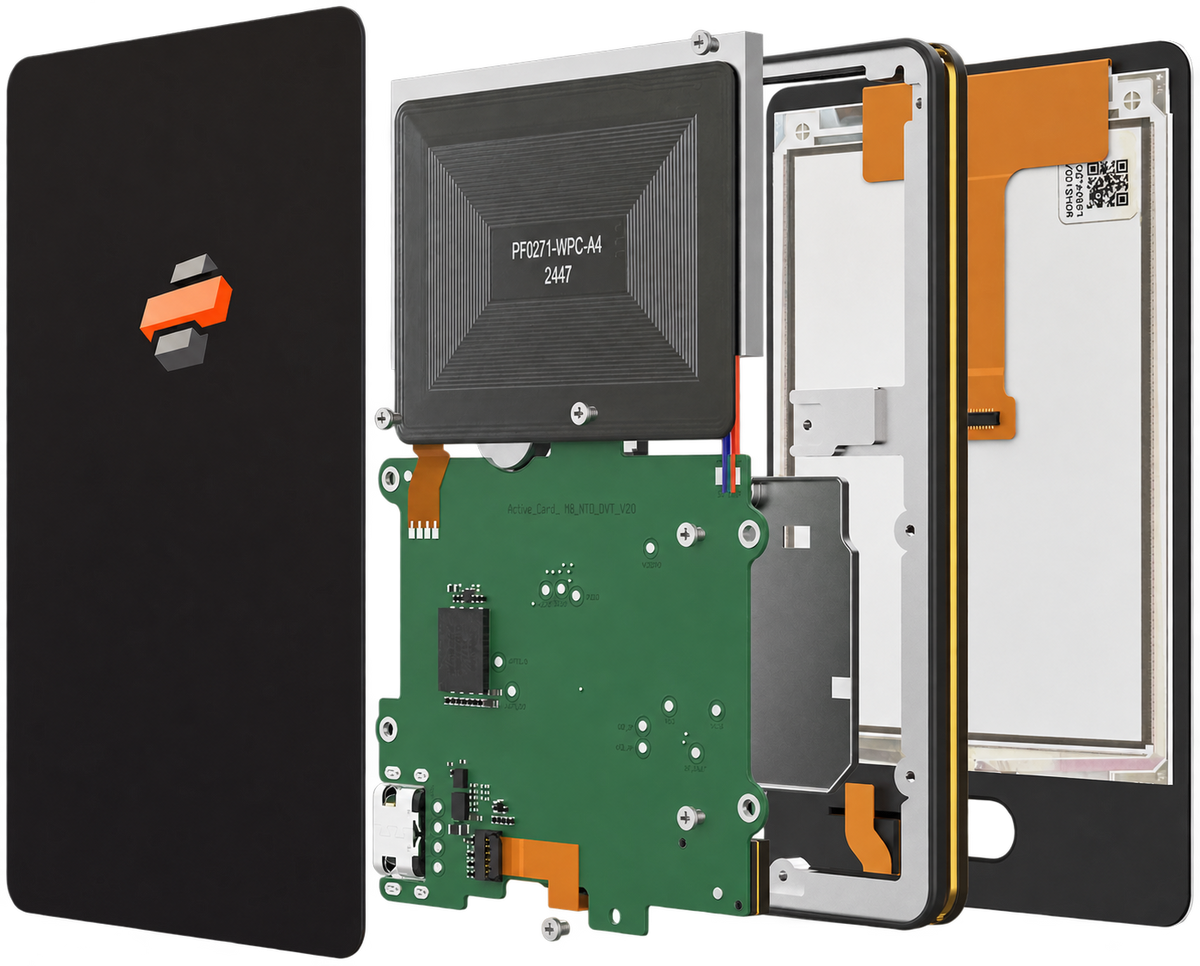
Chip
- Processor
- Daric, CrossBar's security chip, 350 MHz RISC-V core, 22nm TSMC. ARM core disabled
- Memory
- 4 MiB ReRAM, 2 MiB SRAM
- Crypto engine
- SCE, AES, ECDSA, EdDSA
Device
- Connectivity
- USB-C · NFC · BLE · fingerprint
- Display
- 2.8" E Ink touch
- Form factor
- Credit-card size on the Founders Edition. Later units can change shape, while chip, core and firmware stay the same
- Package
- BGA, which keeps the chip flat enough for the card body
Software
- Firmware
- Open source, deterministic build, user-flashable
- OS
- Xous (Rust)
- App storage
- Own file system per app, survives updates
- Locked
- boot0. boot1 flashable with the developer key
Signing
- Signs
- EIP-1559 · EIP-7702 · EIP-191 · EIP-712. BIP-39 seed with passphrase; keys derived on BIP-32 paths, so one seed serves every account
Start from the source.
The repositories the firmware is built from, by level.
First flash? Read the flashing guide first. About 45 minutes from clone to first signature.
Flashing guide →Your app, the Ostros signer and companion apps. You build here.
github.com/ethereum Ethereum signerethereum-appThe Ethereum Foundation's reference signer, Apache-2.0. The Ostros signer joins this repository during Devcon weekXous, system services, the GUI framework, drivers and the boot chain. You call them and verify them.
github.com/betrusted-io · baochip Xous OS, services and appsxous-coreThe Rust microkernel, its services and reference apps
Boot chain bao1x-bootSecure boot, UF2 firmware updates
Drivers bao1x-halUDMA, crypto engine, USB
VS Code extension bao-vscode-extBuild, UF2 flash, serial monitorChip logic, specification, SDK and documentation. You read them and verify them.
github.com/crossbar-inc · baochip Chip logicbaochip-1xThe Daric RISC-V design, RTL and coder's guide, CERN-OHL-W 2.0
Chip specification daric-hardwareSpecification and reference designs
Chip SDK and crypto library daric-sdkSCE library: AES, ECDSA, EdDSA, Paillier, ZKP. The SDK targets the ARM core, which is disabled on CrossBar Ostros
Chip documentation daric-docEVB, RISC-V workflow, tools
Dabao board dabaoBoard hardware for the same silicon, KiCadVerify your unit.
Everything that touches your keys is in the published source, so you check it at your desk.
Follow your keys through the source, from the compute logic to the signer. Rebuild the firmware and compare your hash with the hash of the published firmware. Compare an opened unit with the published board files.
Going further, in a lab. Near-infrared imaging with a rig such as IRIS shows the die itself for comparison with the published design. It needs a package that exposes the back of the die: the chip-scale package on Baochip's Dabao board, which carries the same Daric silicon and is what you see under IRIS at Devcon. The Founders Edition uses a BGA package, so die imaging for this body is done on Dabao. Opening a unit is a one-way step.
Know what you get.
Every release on the roadmap reaches this unit as a firmware update.
- What it is
- A developer device in a small run, for people who build applications for the platform. Each unit of the first limited batch carries its number engraved.
- In the box
- One CrossBar Ostros, active and ready to connect over USB-C.
- On the device
- Xous, the Ostros signer and the web signer, at the firmware current at shipping. Later builds for the Founders Edition are published on the updates page with their hash.
- Peripherals
- Screen, touch and USB-C are live at shipping. Further peripherals switch on with firmware updates.
- Support
- CrossBar engineers answer you directly, on the Discord server and in GitHub issues. Included with the Founders Edition.
- Who sells it
- CrossBar sells the Founders Edition direct, by application. Approved applicants buy in the CrossBar checkout and receive a tracked shipment from CrossBar.
- Price and payment
- Price is shown at checkout after approval. Your unit is reserved for seven days from the approval e-mail.
- Who gets one
- One unit per person. A company team can ask for up to three.
Follow the roadmap to 2027.
Each release is published on the firmware updates page with its hash, and you flash it over USB-C.
FAQ
Applying5 questions
Is this a pre-order?
Yes. You apply, we review, and approved applicants receive a link to buy a unit from the first limited batch.
How do you choose who gets one?
Qualified builders are approved in the order they apply. Tell us what you will build or test and link your GitHub profile.
How long does review take?
We review every five days and reply by e-mail either way.
Can I get more than one?
One unit per person. A company team can ask for up to three in the form and say why.
What happens after approval?
The approval e-mail holds a link to buy, and your unit is reserved for seven days from that e-mail.
Shipping and payment4 questions
Where do you ship?
We ship to Europe, the US and Singapore. Duties and import taxes are added at checkout and vary by country.
When does it ship?
Late November 2026, tracked.
Can I ship to a forwarder?
You can enter a freight forwarder or reshipper as the address type. We review those by hand.
Anything special about shipping?
The device holds a lithium battery, so it ships under dangerous-goods rules. That limits carrier choice and may exclude some addresses.
The device8 questions
Is it a finished product?
It is a developer device in a small run. A retail version for people who do not develop follows on the same platform.
Does the first limited batch differ from later units?
In shape only. Later units can change shape to bring the price down, while the chip, the RISC-V core, Xous and the app platform stay the same.
Can I store funds on it?
Yes. The Ostros signer it ships with is a working single-key wallet.
Does flashing my own firmware wipe the device?
Yes. Back up your seed before you flash.
What if I brick it?
Reflash over USB-C following the flashing guide; a bad OS image recovers that way. If you replace boot1, a bad image can leave the device unusable.
Can I build my own from the repo?
Yes. The software, chip logic and board files are public.
Is there an emulator?
An emulator for development without a device comes with the January 2027 release.
Can I inspect the chip in my unit?
You verify the design at your desk and the die in a lab; Verify your unit has both.
Building13 questions
Where do I find project ideas?
Three starting points are on the Ostros page. A longer list gets its own page; we announce it on Discord.
How does my app get onto the device, and does that change with the app loader?
On the Founders Edition you add your app to the build, build the full firmware image and flash it over USB-C as one file. With the application loader, in the January 2027 firmware release, your app loads on its own into a secure environment without reflashing.
Which services can my app call?
The standard Xous services: USB, the signing service, randomness, cryptographic operations, the key store and the general system services.
What does the UI toolkit give me: screens, menus, dialogs, touch input?
Windows, buttons and switches, plus the display and touch input. Apps draw on the E Ink screen through the toolkit.
How do USB messages from the companion reach my app?
Over the USB-C cable. Your app registers a USB endpoint and receives the messages sent to it.
Is the key store an API, or do I write my own?
An API. Your app derives keys from the seed through the key store. Derived keys stay in memory; if your app needs to keep a key, it can store it.
How does my app call signing, and can it derive its own keys?
Through the signing service. Your app derives the keys it needs from the key store and asks the signing service to sign.
How much memory and storage does an app get, and does it survive an update?
Memory is assigned dynamically. Each app has its own file system, and its data survives updates.
Can my app use the fingerprint sensor, NFC or Bluetooth?
Fingerprint, NFC and Bluetooth switch on with firmware updates.
Will there be firmware updates for the Founders Edition?
Yes. Builds for the Founders Edition are published on the updates page, with the image hash. You flash them over USB-C the same way as your own image. Signed over-the-air updates are in the pipeline too.
Which licence covers the Ethereum signer, and can I ship a fork?
Apache-2.0. Yes, you can ship a fork.
How do I report a security issue?
Write to security@crossbar-inc.com; the disclosure page has the scope and the timelines.
Is there a silicon errata list for the chip?
Known issues in the Daric silicon are tracked in the baochip-1x issues, from Baochip's own bring-up and from the DEF CON 34 badge. We link the errata document here when Baochip publishes one.
Talk to us.
Ask questions, report bugs and share ideas on the Discord server and in GitHub issues. Mention CrossBar Ostros.
- We message you only after you apply, and we quote the e-mail address you applied with.
- We never ask for seed phrases or PINs.
- Payment happens only in the CrossBar checkout, after your individual approval e-mail.
Curious what comes next?
Leave your e-mail and we will write twice: once when the Ostros signer is published, and once when the next edition opens.